You’ve been told you have a carcinoma, and it is a word that carries immediate weight. In the same breath, you’re told it’s Stage 0, non-invasive, and perhaps not even “true” cancer yet. Hearing those statements together feels contradictory, leaving you with a very specific, isolating kind of anxiety that’s hard to articulate to anyone who hasn’t experienced it.
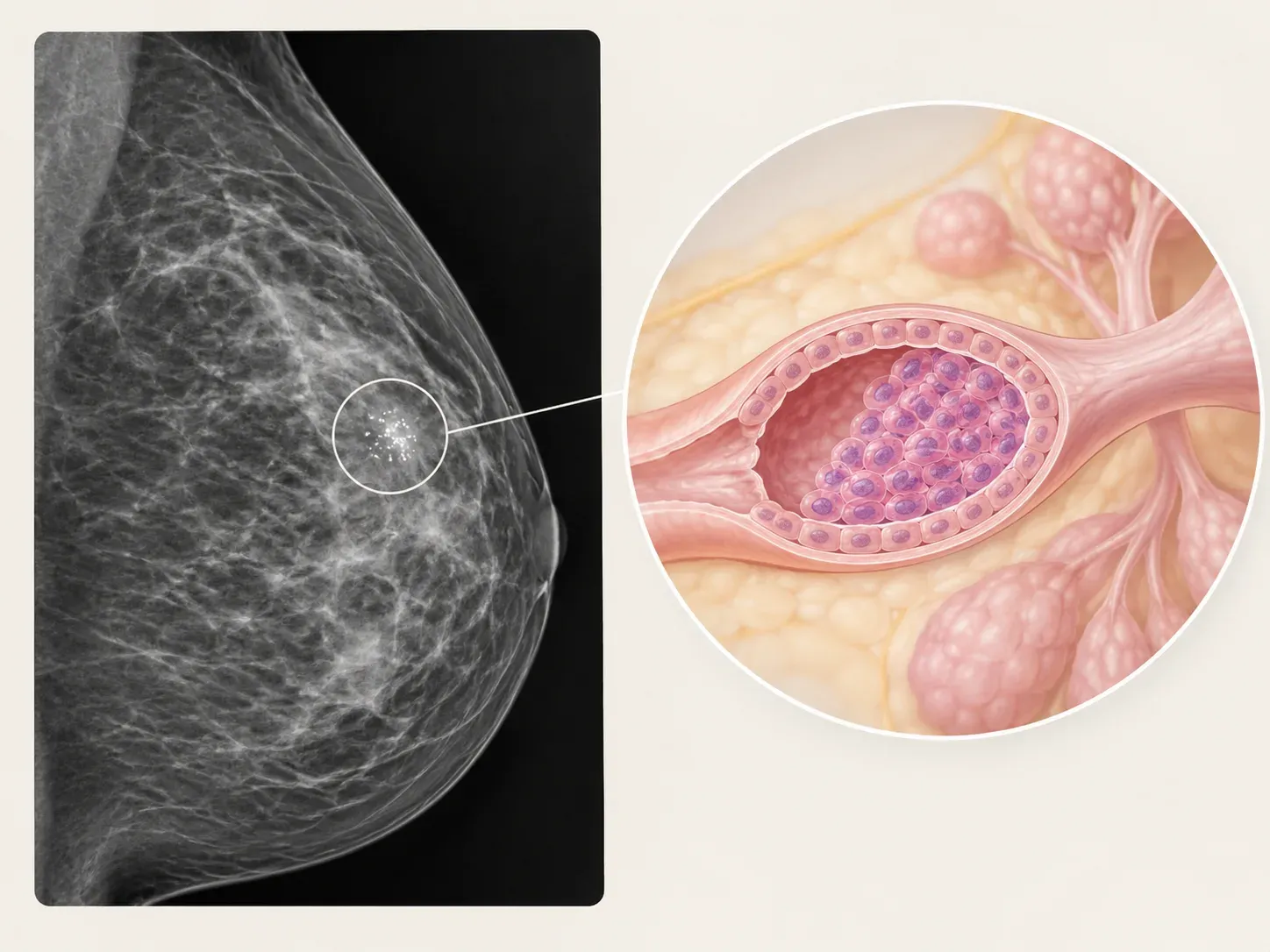
Here is the clearest way to frame it: DCIS is a collection of abnormal cells confined strictly inside a milk duct. Because they haven’t broken through the duct wall into surrounding tissue, they lack the ability to travel or spread elsewhere in your body. In fact, 20 years after a DCIS diagnosis, the risk of dying from breast cancer is around 3.3%, a statistic that is deeply reassuring, even if it isn’t zero and varies from person to person.
This guide unpacks what DCIS actually is, what the long-term data really means, whether it will ever progress, and why medical experts are actively debating how aggressively it needs to be treated.
Demystifying DCIS: What “In Situ” Really Means
To understand DCIS, it helps to start with the anatomy. Your breast tissue contains a network of tiny ducts designed to carry milk toward the nipple.
- Ductal means the abnormal cells are inside those ducts.
- Carcinoma means the cells look like cancer under a microscope.
- In situ is Latin for “in its original place” and it is the most critical phrase in your diagnosis.
In invasive breast cancer, abnormal cells break through the protective wall of the duct, giving them access to blood vessels and lymph channels that carry them elsewhere in the body. DCIS cells have not broken through. The duct wall remains entirely intact.
Because those boundaries hold, DCIS is classified as Stage 0. As long as it remains in situ, it simply lacks the biological ability to metastasize.
The Naming Controversy: When Words Cause Unnecessary Fear
The medical community increasingly acknowledges that the term “carcinoma” creates a psychological crisis that the biology does not justify. Hearing the word “cancer” triggers an immediate threat response, even though DCIS behaves very differently than invasive disease.
There is an ongoing push among oncologists to rename these lesions, perhaps to something like “ductal intraepithelial neoplasia”, to prevent patients from feeling pressured into aggressive decisions out of fear. While the official name hasn’t changed yet, know that the gap between the scary label and its low actual risk is well documented.
How DCIS Is Detected
Roughly 20% of all screen-detected breast cancers are DCIS.
- Mammograms: Most cases are found during routine screening as microcalcifications: tiny flecks of calcium deposited inside the duct long before anything can be felt.
- Symptoms: In a smaller number of cases, DCIS presents as a palpable lump or nipple discharge.
Why Grade Matters More Than Size
When you read your pathology report, you’ll notice several details beyond the size of the area:
- Nuclear Grade (Low, Intermediate, or High): Measures how different the cells look from normal, healthy cells, and how fast they are dividing.
- Comedo Necrosis: Notes whether there is a core of dead cells inside the duct, which often signals a higher-grade, faster-growing lesion.
- Hormone Receptor Status: Indicates whether the cells grow in response to estrogen or progesterone.
These microscopic details, rather than the sheer physical size of the lesion, are what truly drive your treatment conversation and prognosis.
The Numbers That Matter Most
When looking at long-term outcomes, the statistics surrounding DCIS are overwhelmingly reassuring:
- 20-Year Survival Rate: In a large observational study following women over two decades, the overall risk of dying from breast cancer after a DCIS diagnosis was 3.3%.
- Annual Mortality: Across the entire follow-up period, the breast cancer mortality rate averaged just 0.12% per year.
Put simply, the vast majority of women diagnosed with DCIS live a full, normal lifespan and ultimately die of something entirely unrelated.
Why Risk Isn’t the Same for Everyone
General statistics offer macro-level reassurance, but individual risk is nuanced and deserves candid discussion:
- Age at Diagnosis: Being diagnosed at a younger age (especially under 40) carries a higher risk of dying from breast cancer.
- Racial Disparities: For Black women diagnosed before age 50, the 20-year risk of breast cancer mortality rises to 8.1%, substantially higher than the population average.
If you fall into one of these higher-risk groups, general averages may not paint an accurate picture for you, and your care team should tailor your treatment plan accordingly.
Why Do We Treat Stage 0 Cancer?
Overall recurrence runs around 20%, with roughly half of those recurrences presenting as invasive breast cancer. This underscores the primary goal of treatment: doctors treat DCIS not because the current cells are immediately dangerous, but to prevent invasive disease from developing down the line.
The Hard Question: Will It Become Invasive?
This is the question every patient wants answered, and the honest medical truth is uncomfortable: Some DCIS will progress to invasive cancer if left alone. Much of it never would. And right now, medicine cannot reliably tell you which type you have.
Estimates vary across research studies, but overall, between 25% and 60% of untreated DCIS progresses to invasive breast cancer over 9 to 24 years. The nuclear grade provides the strongest clue:
- Low to Intermediate Grade: Progression risk sits around 30%.
- High Grade: Progression risk rises toward 60%.
The Paradox of Overdiagnosis
When you look at those numbers from another angle, the dilemma becomes clear: A substantial portion of DCIS, possibly 40% or more, would never cause harm in a person’s lifetime.
When screening detects and treats these indolent lesions, it results in overdiagnosis. The patient undergoes surgery, potentially radiation, and years of emotional distress for a condition that was never going to threaten their life.
Overdiagnosis is not a fringe theory, it is openly acknowledged in oncology research, and it is the primary driver behind current clinical trials seeking safer, less invasive alternatives.
Why Is DCIS Still Treated so Aggressively?
If so much DCIS is harmless, why isn’t watchful waiting the standard?
Because doctors currently lack a definitive biomarker or diagnostic tool to separate the high-risk lesions from the harmless ones. Faced with that uncertainty, standard care defaults to treating all cases to eliminate the danger.
While genomic tests can help estimate recurrence risk and guide decisions about radiation, no test can yet predict with 100% certainty whether an individual DCIS lesion will remain dormant or turn invasive.
How DCIS Is Treated and Why?
Because Stage 0 DCIS cannot spread outside the milk duct, treatment isn’t aimed at saving your life today; it’s designed to prevent future local recurrences or invasive cancer down the road.
1. Surgery (The Primary Step)
Surgery removes the abnormal ductal cells and establishes “clear margins”, a rim of healthy tissue surrounding the lesion.
- Lumpectomy (Breast-Conserving Surgery): The standard choice for most women. Only the affected area and a safety buffer of surrounding healthy tissue are removed. Lymph node sampling is usually unnecessary during a lumpectomy because in situ cells cannot travel to the lymph nodes.
- Mastectomy: Recommended if the DCIS is extensive, spans multiple areas of the breast, or if clear margins cannot be achieved with lumpectomy. A sentinel lymph node biopsy is typically performed concurrently for practical reasons, as lymph node mapping becomes far more difficult if invasive cancer is unexpectedly found on final pathology after the breast tissue is removed.
2. Radiation Therapy (Lowering Local Risk)
Radiation following a lumpectomy roughly halves the risk of DCIS or invasive cancer returning in that breast.
However, studies show radiation does not improve breast cancer survival for most patients. Why? Because the local recurrences radiation prevents are almost always treatable if they ever occur. For patients with low-risk DCIS, skipping radiation is a reasonable, evidence-based choice:
The Long-Term Data on Skipping Radiation
In a landmark 20-year follow-up study of lumpectomy without radiation, the risk of a recurrence in the same breast was:
- 17.8% for lower-risk DCIS
- 28.7% for higher-risk DCIS
3. Endocrine (Hormone) Therapy
If pathology confirms your DCIS is hormone receptor-positive (ER/PR+), daily medications like tamoxifen or aromatase inhibitors may be offered for up to five years.
- The Benefit: Reduces the risk of local recurrence and lowers the chance of developing a new primary cancer in the opposite breast.
- The Trade-Off: Requires daily compliance and can cause menopausal side effects, bone density loss, or joint pain.
Preference-Sensitive Decisions, Not Medical Imperatives
Every added intervention, from radiation to hormone therapy, reduces your numerical risk of recurrence. But each also comes with a real cost in physical side effects, time, and quality of life.
Because overall survival across all treatment pathways is extraordinarily high, these choices are deeply personal preferences. Your decision comes down to balancing your personal tolerance for recurrence risk against the daily physical impact of treatment.
Where the Debate Is Live: Active Monitoring
If much DCIS never progresses, could some patients safely skip surgery and choose close monitoring instead? Four landmark international trials (COMET, LORIS, LORD, and LORETTA) were designed to answer that exact question, and early results are reshaping the conversation.
The COMET trial (published in JAMA in December 2024) followed 957 women with low-risk, hormone-receptor-positive DCIS, comparing standard care (surgery, with or without radiation) against active monitoring with mammograms every six months. At two years:
- The rate of invasive cancer was 4.2% in the active monitoring group versus 5.9% in the standard care group, demonstrating that active monitoring met non-inferiority thresholds.
- Among participants who strictly adhered to their assigned protocol, the rates were 3.1% versus 8.7%, which the authors said supports active monitoring being superior, although many participants did not stick to their assigned group.
Important Caveats to Keep in Mind
While these early results are encouraging, experts emphasize several crucial nuances:
- Two years is a short window: DCIS progression or recurrence can take a decade or longer to manifest.
- Hormone therapy played a role: Over 70% of the active monitoring group took daily endocrine therapy, which likely helped suppress progression.
- Strict eligibility: These findings apply only to low-risk, hormone-receptor-positive DCIS and not to high-grade disease.
What This Means for You Right Now
Active monitoring is not yet standard clinical practice outside of formal research. If you have low-risk DCIS and want to avoid immediate surgery, the safest path is to ask your oncologist if an active monitoring trial is open near you rather than declining standard care independently.
Alongside these trials, the debate over renaming DCIS continues. Some oncologists argue that dropping the word “carcinoma” would prevent panic and over-treatment, while others worry it might lead patients to underestimate the cases that genuinely do turn invasive. Both perspectives highlight the subtle balance required when treating Stage 0 disease.
Your Next Steps: Navigating the Appointment
Questions to Ask Your Oncology Team
- “What is my specific grade, and is my DCIS hormone-receptor positive?”
- “Based on my grade, lesion size, and surgical margins, what is my estimated recurrence risk with and without radiation?”
- “Would a genomic risk-score test change your treatment recommendation for me?”
- “Am I eligible for any active monitoring trials like COMET?”
- “Do general DCIS statistics apply neatly to my age and background?”
- “What approach would you recommend if my priority is receiving the least invasive treatment that is still safe?”
Three Key Principles to Remember
- You Have Time: DCIS is not a surgical emergency. Taking two to three weeks to seek a second opinion and gather your thoughts is entirely safe and medically sound.
- Keep Your Pathology Report: Your nuclear grade, margin width, lesion size, and hormone-receptor status drive every treatment decision.
- Your Preferences Matter: Because 20-year survival is extremely high across all standard pathways, your personal risk tolerance and values are valid inputs into your care plan.
A Final Word
DCIS occupies a unique space in modern medicine: significant enough to warrant attention, yet indolent enough that leading researchers are actively questioning whether we treat it too aggressively.
Sitting with that ambiguity can be challenging right after a diagnosis. But it also carries a profoundly reassuring truth: you are not in a race against time, you have meaningful choices, and the overwhelming probability is that this will never shorten your life.
This page describes DCIS in general terms. The figures quoted are population averages, and your own risk depends on the grade and size of your DCIS, your margins, your hormone receptor status, your age, and your family and personal history. The outcome data here reflects people who received standard treatment, so it should not be read as describing what happens without it. Nothing on this page should be used to decline or delay recommended treatment. Active monitoring is currently a research strategy rather than standard care, and access to it belongs in a conversation with your breast team.
Common questions
Is DCIS cancer?
DCIS is a collection of abnormal cells that look like cancer under a microscope but are confined inside a milk duct. Because they have not broken through the duct wall into surrounding tissue, they lack the ability to spread elsewhere in your body. That is why it is classified as Stage 0, and why some oncologists have proposed renaming it to drop the word carcinoma.
What are the chances of dying from DCIS?
Low. In a large study following women for 20 years after a DCIS diagnosis, the risk of dying from breast cancer was 3.3%, an average of 0.12% per year. Risk is not the same for everyone: it is higher for women diagnosed young, and for Black women diagnosed before age 50 the 20-year risk was 8.1%.
Will DCIS turn into invasive cancer?
Some DCIS will progress to invasive cancer if left alone, and much of it never would, but medicine cannot yet reliably tell you which type you have. Estimates suggest between 25% and 60% of untreated DCIS becomes invasive over many years, around 30% for low and intermediate grade and rising toward 60% for high grade.
Do I need radiation after a lumpectomy for DCIS?
Radiation after a lumpectomy roughly halves the risk of DCIS or invasive cancer returning in that breast. For patients with low-risk DCIS, skipping radiation is a reasonable choice to discuss with your team. In a 20-year study of lumpectomy without radiation, the risk of a recurrence in the same breast was 17.8% for lower-risk DCIS and 28.7% for higher-risk DCIS.
Is active monitoring an option for DCIS?
Not yet outside research. In the COMET trial of 957 women with low-risk, hormone-receptor-positive DCIS, the two-year rate of invasive cancer was 4.2% with active monitoring against 5.9% with standard treatment. Two years is a short window and the results apply only to low-risk disease, so ask your oncologist whether an active monitoring trial is open near you rather than declining standard care on your own.
Sources
- Association of a Diagnosis of Ductal Carcinoma In Situ With Death From Breast Cancer · JAMA Network Open, 2020 · doi:10.1001/jamanetworkopen.2020.17124
- Active Monitoring With or Without Endocrine Therapy for Low-Risk Ductal Carcinoma In Situ: The COMET Randomized Clinical Trial · JAMA, 2024 · doi:10.1001/jama.2024.26698
- COMET Trial Finds Active Monitoring Is a Viable Option for Some Patients With Low-risk DCIS · American Association for Cancer Research, 2024
- Some Patients With Low-Risk Ductal Carcinoma In Situ May Be Able to Avoid Surgery · The ASCO Post, 2025
- Active Monitoring May Be as Good as Surgery for Low-Risk DCIS · Breastcancer.org, 2024
- Outcomes from low-risk ductal carcinoma in situ: a systematic review and meta-analysis · Breast Cancer Research and Treatment, 2024 · doi:10.1007/s10549-024-07473-w
- Progression from ductal carcinoma in situ to invasive breast cancer: molecular features and clinical significance · Signal Transduction and Targeted Therapy, 2024 · doi:10.1038/s41392-024-01779-3
- Lumpectomy without radiation for ductal carcinoma in situ of the breast: 20-year results from the ECOG-ACRIN E5194 study · npj Breast Cancer, 2024 · doi:10.1038/s41523-024-00622-w
- Paradigm Shift toward Reducing Overtreatment of Ductal Carcinoma In Situ of Breast · Frontiers in Oncology, 2017 · doi:10.3389/fonc.2017.00192
- Overdiagnosis and overtreatment of breast cancer: Progression of ductal carcinoma in situ: the pathological perspective · Breast Cancer Research, 2006 · doi:10.1186/bcr1397