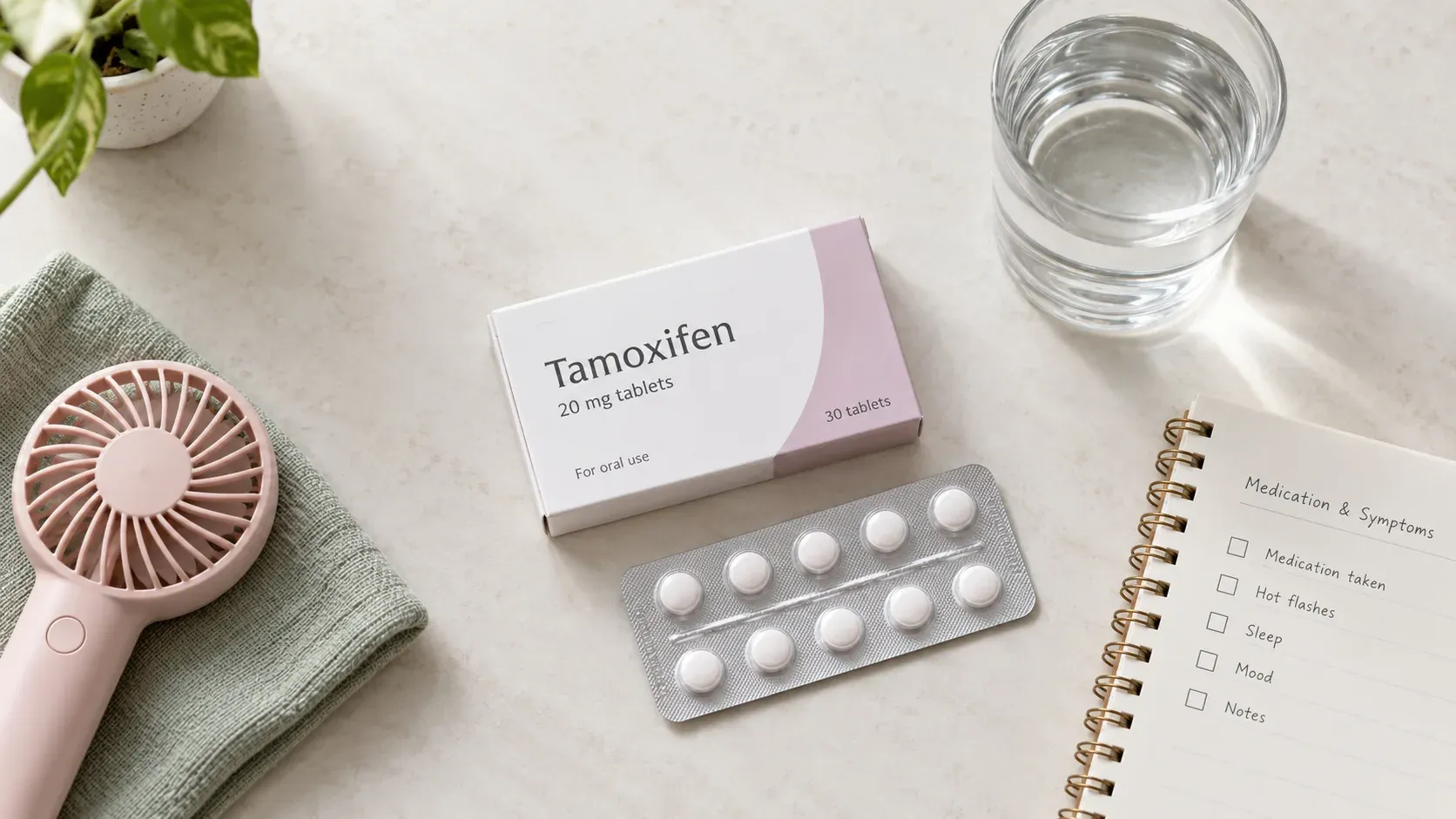
Most people on tamoxifen get hot flashes, disrupted sleep, and vaginal dryness, and for many of them the worst of it settles within the first two or three months. A small number of side effects are serious enough to need a phone call rather than a wait-and-see, and those are worth learning now so you can recognize them later. This page covers what’s typical, what’s rare, what usually helps, and where the evidence is genuinely unsettled.
If you started this medication recently, the appointment where it was explained probably went by faster than you wanted.
How Tamoxifen Works in Your Body
Tamoxifen is a selective estrogen receptor modulator. The useful word in that phrase is selective.
It doesn’t lower your estrogen. It sits on estrogen receptors and then behaves differently depending on which tissue it’s in. In breast tissue it blocks estrogen, which is the point if your cancer is hormone receptor-positive. In bone and in the lining of the uterus, it does something closer to the opposite, acting a little like estrogen itself.
That split explains most of what follows. It’s why the symptoms feel like menopause even though your estrogen hasn’t dropped. It’s why tamoxifen can strengthen bone in one person and thin it in another. And it’s why the uterus needs watching.
One more piece of biology. Tamoxifen arrives in your body inactive. Your liver converts it, using an enzyme called CYP2D6, into the form that does the work. That conversion step matters later, when we get to other medications.
Understanding What Most People Feel: You’re Not Alone in This
In one survey of patients on hormone therapy, around 8 in 10 reported at least one side effect. Severity varies enormously. Some people barely notice.
Hot flashes and Night Sweats
By far the most common complaint, affecting anywhere from a quarter to two-thirds of patients depending on the study. They usually peak early on and ease over the first few months, though they can persist longer for some people.
Vaginal dryness
Affects about a third of patients and frequently leads to discomfort, irritation, or pain during sex. Vaginal discharge and a lower sex drive are also very common, and that drop in libido is rarely just about hormones. Pain, exhaustion, and the sheer emotional weight of a cancer diagnosis all play a role.
Changes to your period
If you haven’t gone through menopause yet, your periods may become irregular, much lighter, or stop completely. However, a missed period doesn’t mean you can’t get pregnant. Because tamoxifen causes serious birth defects, you’ll need to use non-hormonal birth control (like condoms or a copper IUD) while taking it. If you hope to have children in the future, it’s crucial to discuss fertility preservation with your team before starting treatment.
Sleep and Mood
Sleep issues affect roughly a third of people on treatment. Feeling irritable, down, or foggy is also very common. Pinpointing the exact cause can be tricky, though: poor sleep by itself causes low mood and brain fog, but so does chemotherapy, and so does the stress of dealing with cancer itself.
Everything else
Fatigue, joint aches, nausea, headaches, fluid retention, hair thinning, and weight change are all reported. The weight data from trials is genuinely mixed, partly because chemotherapy and menopause and reduced activity tend to arrive relatively at the same time.
The Rarer Risks: What to Keep in Mind
These side effects are rare. Still, they are the exact reason your care team monitors you so closely.
Tamoxifen and the Uterus: What to Watch For
Because tamoxifen acts like estrogen in the uterine lining, it can thicken it and raise the risk of endometrial cancer. The risk sits almost entirely with postmenopausal women. In a large prevention trial, endometrial cancer occurred in about 3 women per 1,000 per year on tamoxifen, against fewer than 1 per 1,000 on placebo, and the increase showed up in women over 50 but not in younger ones. The American Cancer Society puts the lifetime risk around 1 in 500. Most cases are caught early, when treatment works well, which is exactly why unexplained bleeding is not something to sit on.
Blood clots
Tamoxifen modestly raises the risk of clots in the legs and lungs. In one trial of 900 women, around 2% on tamoxifen had a clotting event compared with under 1% on letrozole. Risk climbs surrounding surgery, long immobility, and long flights, so mention those to your team in advance.
Bone Health
This one goes in opposite directions and surprises people. If you’re postmenopausal, tamoxifen generally protects bone, with trials showing small annual gains at the spine. If you’re premenopausal, studies have found meaningful annual loss, on the order of 1.4% a year at the lumbar spine. Premenopausal patients should ask whether a baseline DEXA scan makes sense (a DEXA scan is a quick, painless, low-dose X-ray that measures bone strength and checks for bone thinning; you simply lie on an open table for 10 to 15 minutes while the machine scans your body, making it a very easy way to track your bone health).
Vision changes
Tamoxifen carries a small risk of cataracts and, much less commonly, changes to your cornea or retina. If you notice any new blurriness or vision changes, report it to your care team right away rather than waiting for your next scheduled checkup.
What this means day to day
Most side effects can be treated directly, and asking for specific relief options usually gets better results than simply saying you feel rough.
Hot flashes respond to non-hormonal prescription options that have been studied specifically in breast cancer survivors, including certain antidepressants and gabapentin. Vaginal dryness starts with non-hormonal moisturizers and lubricants. Local estrogen is a more complicated conversation in hormone-positive disease, and one for your oncologist rather than a pharmacy shelf. For sleep, cognitive behavioral therapy for insomnia has strong evidence and doesn’t add another drug. For bone, weight-bearing exercise, calcium, and vitamin D.
The General Timeline: The first two to three months are usually the toughest. Hot flashes, nausea, and headaches often fade over time, while dryness and sleep issues are more likely to linger, though fortunately those are the ones that respond best to targeted treatment. Most side effects clear up once you finish tamoxifen entirely. If a symptom is worse at month four than it was at month one, that isn’t a failure, it’s simply valuable information to share with your doctor.
Keep a brief log of what you feel and when it happens. Specific details make it much easier for your doctor to give you specific solutions.
Where the Science Is Unsettled
Two things are genuinely contested, and you’ll find confident answers on both sides online.
Antidepressants & Tamoxifen
Your liver relies on an enzyme called CYP2D6 to turn tamoxifen into its active, cancer-fighting form. Certain antidepressants, like paroxetine, fluoxetine, and bupropion, block this enzyme and might make tamoxifen less effective. Studies disagree on whether this truly affects cancer outcomes, and medical guidelines vary globally, but most doctors play it safe: if you need an antidepressant, they will choose an option with minimal impact on CYP2D6, such as venlafaxine, sertraline, citalopram, or escitalopram. The most important rule: never stop an antidepressant on your own. Instead, discuss your medications with both your oncologist and your prescribing doctor so they can adjust things safely together.
How long to stay on it
Five years was the standard for a long time. Newer trials show that stretching to ten years provides a real benefit for some people, but little to no extra benefit for others; it mostly comes down to your individual risk of recurrence. Deciding on five years versus ten is an ongoing conversation with your care team, not a set rule.
Tamoxifen and what is next
Call your team the same day if you notice any of the following.
- Vaginal bleeding, spotting, or unusual discharge, particularly after menopause
- Pelvic pain or pressure
- Pain, swelling, redness, or warmth in one leg
- Sudden breathlessness or chest pain (911)
- New or changing vision problems
- Sudden weakness, numbness, or difficulty speaking (911)
Before your next routine appointment, write down three things: which symptoms are affecting your daily life most, a full list of every medication and supplement you take including over-the-counter ones, and whether anyone has checked your bone density if you’re premenopausal.
Stopping tamoxifen early is associated with higher recurrence and higher mortality, and more than a third of women in one real-world study had stopped within three and a half years. That statistic is usually read as a warning to patients. It’s better read as an argument for treating side effects properly, early, and out loud.
The figures on this page come from clinical trials and population studies, and describe averages across large groups. Your own risk depends on your menopausal status, your cancer, your other medications, and your medical history, and it may differ substantially from the numbers here. Nothing on this page should be used to start, stop, or change a dose. If you are having chest pain, sudden breathlessness, or symptoms of a stroke, call emergency services.
Common questions
How long do tamoxifen side effects last?
The first two to three months are usually the hardest. Hot flashes, nausea, and headaches often ease after that. Vaginal dryness and sleep disruption are more likely to persist, and they are also the ones that respond best to treatment. Most effects resolve once tamoxifen ends. If something is worse at month four than it was at month one, that is information worth reporting rather than a sign you are failing at it.
Which tamoxifen symptoms mean I should call the same day?
Vaginal bleeding, spotting, or unusual discharge, particularly after menopause. Pelvic pain or pressure. Pain, swelling, redness, or warmth in one leg. Sudden breathlessness or chest pain. New or changing vision problems. Sudden weakness, numbness, or difficulty speaking. If you are having chest pain, sudden breathlessness, or symptoms of a stroke, call emergency services rather than waiting.
Does tamoxifen cause endometrial cancer?
It raises the risk, and the risk sits almost entirely with postmenopausal women. In a large prevention trial, endometrial cancer occurred in about 3 women per 1,000 per year on tamoxifen against fewer than 1 per 1,000 on placebo, and the increase showed up in women over 50 but not in younger ones. Most cases are caught early, when treatment works well, which is exactly why unexplained bleeding is not something to sit on.
Can I take an antidepressant while I'm on tamoxifen?
Usually yes, but the choice matters. Your liver needs an enzyme called CYP2D6 to activate tamoxifen, and paroxetine, fluoxetine, and bupropion block it strongly. Studies of whether this changes cancer outcomes have produced conflicting results and guidelines differ between countries, so most clinicians pick an alternative with little CYP2D6 effect where one will do the job. Do not stop an antidepressant on your own. Bring it to your oncologist and your prescriber together.
Does tamoxifen affect my bones?
It goes in opposite directions depending on your menopausal status, which surprises people. If you are postmenopausal it generally protects bone, with trials showing small annual gains at the spine. If you are premenopausal, studies have found meaningful annual loss. Premenopausal patients should ask whether a baseline DEXA scan makes sense.
Sources
- Tamoxifen Citrate · National Cancer Institute, 2024
- Tamoxifen and Uterine Cancer · American College of Obstetricians and Gynecologists, 2014
- Endometrial Cancer · Breastcancer.org, 2023
- Tamoxifen: Uses, Side Effects & Risks · Cleveland Clinic, 2023
- Clinical and biomarker predictors of side effects from tamoxifen · Breast Cancer Research and Treatment, 2012
- Effect of tamoxifen on bone mineral density measured by dual-energy x-ray absorptiometry in healthy premenopausal and postmenopausal women · Journal of Clinical Oncology, 1996
- Adverse effects of tamoxifen treatment on bone mineral density in premenopausal patients with breast cancer: a systematic review and meta-analysis · Breast Cancer, 2024
- Adherence to Adjuvant Endocrine Therapy in Breast Cancer Patients · Current Oncology, 2023
- Tamoxifen Discontinuation Rates Surprisingly High in Clinical Practice · CancerNetwork, 2007
- Clinical Update 2025: Recommendations on the Use of Antidepressants in Women Taking Tamoxifen · MGH Center for Women's Mental Health, 2025
- Time to Update Evidence-Based Guideline Recommendations About Concurrent Tamoxifen and Antidepressant Use? A Systematic Review · Clinical Breast Cancer, 2022
- Ten Years of Tamoxifen Reduces Breast Cancer Recurrences, Improves Survival · National Cancer Institute, 2013
- Tamoxifen and Raloxifene to Lower Breast Cancer Risk · American Cancer Society, 2026
- Hot Flashes and Night Sweats (PDQ®)–Health Professional Version · National Cancer Institute, 2025